DISTRIBUTOR-FIRST SUPPLY PARTNER · SINCE 1999 Live · Pneumatic Automation System

SPC Company
Pneumatic Automation / Motion Control / Speed & Flow Controls / Flow Control Valve
Layer 05 · Motion Control Value · Sang-A
What it is

Flow Control Valve

Compare tiers ↓

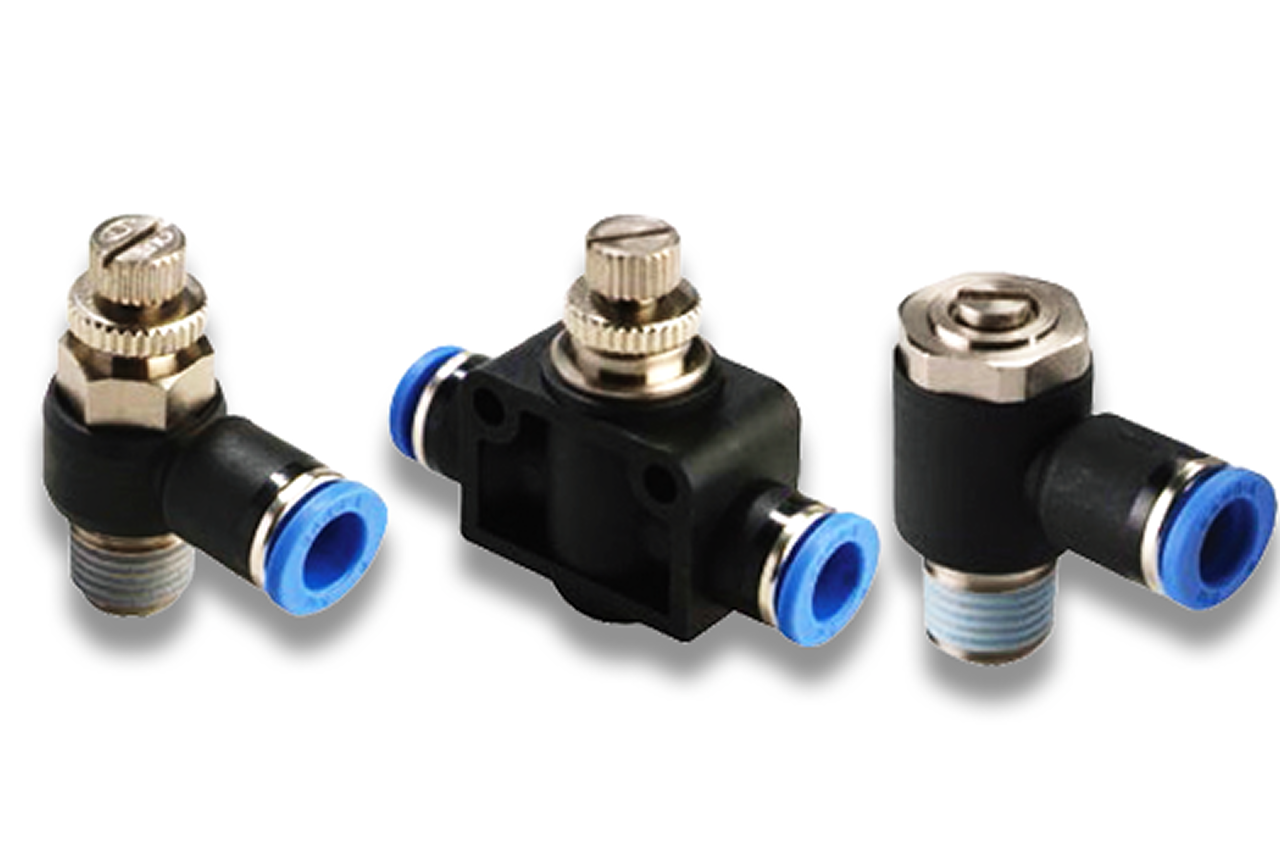
A flow control valve is an inline needle valve that meters air flow in a pneumatic line in BOTH directions equally. Turning the knurled knob advances or retracts a metering needle, narrowing or widening the flow path. Unlike a speed controller it has no integral check valve: that single difference is the entire spec conversation. The flow control is the right tool for line-level jobs: balancing a branch so two parallel circuits draw their fair share, slowing a pilot signal so a sequenced motion doesn't fire too early, trimming the feed to a sub-circuit that doesn't need the full system flow. It is the WRONG tool for cylinder speed (which needs one-direction throttling, see speed-controller). It installs in series in the line and is sized to the same tube OD as the machine's push-to-connect fittings.
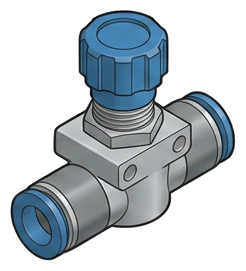
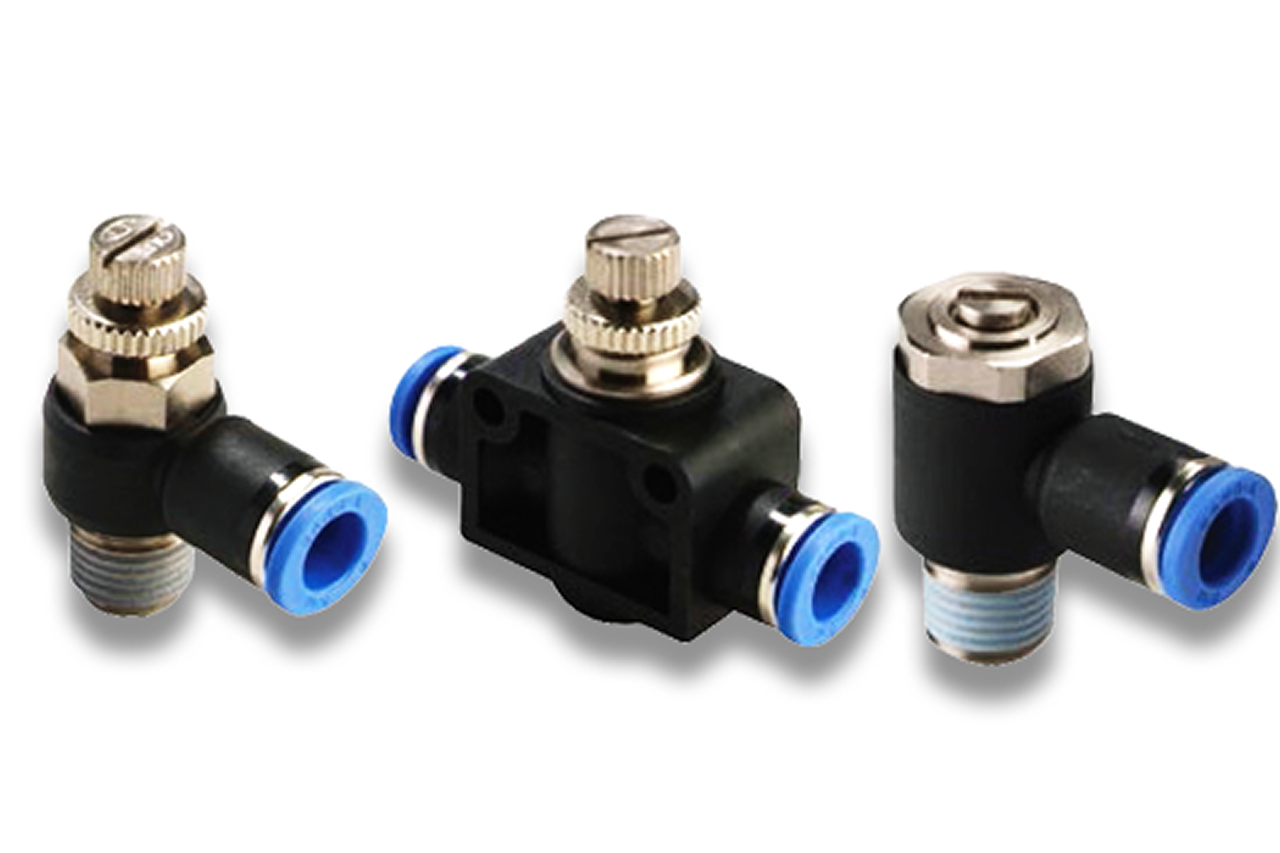
Pictorial Representative flow control valve
Flow Control Valve — representative illustration
Real-world reference Representative flow control valve
Flow Control Valve — representative product photo
Why it's needed

Why this matters.

When the flow control valve is the right call, and when to spec something else. Review the points below.

01 · Key point
In-line adjustable restriction.

A knurled-knob needle valve in series with the line, open for more flow, close for less, change is immediate. The most-used adjustment device in a pneumatic shop after the regulator. Tunes flow without re-piping.

02 · Key point
No integral check, meters both ways.

That single difference from a speed controller is the entire spec conversation. The flow control meters BOTH directions equally, right for line balancing, pilot signal timing, and sub-circuit trimming; wrong for cylinder speed.

03 · Key point
Four jobs cover the catalog.

Line balancing on parallel circuits. Pilot signal timing for soft-start or sequenced motions. Sub-circuit trimming on shared supplies. General line restriction on test stands. A few per machine, scattered across the schematic.

04 · Pro tip
Size against actual flow, not tube OD.

Operational flow should fall in the middle of the needle's usable travel. Oversized = "barely cracked", small adjustments produce huge flow changes, fine-tuning impossible. Undersized = full open and still restricting. After tuning, engage the lock and paint-pen the position so drift is visible.

05 · Where not to use
Cylinder speed control.

About a third of "I need a flow control" calls are speed-controller calls in disguise. Bidirectional metering doubles cylinder cycle time and creates jerky load-dependent motion. → Re-spec to speed controller at the cylinder port, integral check delivers one-direction throttling, which is what cylinder speed actually needs.

06 · Where not to use
One-way backflow blocking.

A flow control throttles but never blocks reverse flow. → Re-spec to check valve when the job is full one-way blocking, load holding on a cylinder, backflow prevention on a shared supply, or pneumatic-only logic.

07 · Where not to use
Manual isolation for service.

A flow control is always at least partly open; it can't be locked off for OSHA lockout-tagout. → Re-spec to quarter-turn shutoff valve when the job is manual full isolation. Different mechanism, different job.

Key selection criteria

What we need to spec it right.

From the machine spec sheet to the part number. Answer what you know, leave the rest blank, and send.

04Choose your priority  ·  core differentiator

Whatever your lever — performance, value, or price — SPC has the right brand.

Pick the priority; the quote desk handles the cross-reference.

02 Value 1 brand
Where it's used

Industries served.

Each industry below uses this product across the listed areas. Open an industry to see how it fits the rest of its system.

Also applies to Line balancing on multi-branch pneumatic circuits · Pilot signal timing on sequenced machines · Sub-circuit feed restriction · Pneumatic logic and timing circuits · Test stand flow tuning · Tool-line throttling

Install · 5 critical steps

The things that matter on the first install.

Step 02
Mount with the adjustment accessible
The flow control is meant to be adjusted in service. A tight cabinet location or behind other equipment defeats the adjustability. Locate where a tech can reach the knurled knob with the line under pressure for live tuning. Panel-mount variants exist for behind-panel adjustment.
Step 03
Thread sealant by thread type
Same as check valves: NPT needs sealant on the male thread (PTFE tape, 2-3 wraps in the direction of engagement). BSPP seals at the face with an O-ring or bonded washer, no sealant on threads. Mixing methods causes leaks at the wrong location.
Step 04
Set the needle to roughly mid-travel before pressurizing
Most flow controls ship fully open or fully closed depending on the manufacturer. Mid-travel at first pressurization gives a known starting point and prevents zero-flow or full-flow surprises.
Step 05
Tune with the line running, not static
Flow controls behave differently under flow vs. at rest. Tune with the actual application running, observe the downstream behavior and adjust the needle in small increments. Static adjustments rarely land on first try.
Step 06
Lock the setting against unintended adjustment
Most knurled-knob flow controls include a locking ring or set screw that prevents the knob from moving after the setting is dialed in. Engage the lock after tuning is complete. Without the lock, the next service tech (or vibration, or a snagged hose) will move the setting and re-create the problem the valve was installed to solve. Paint-pen the final position so drift is visible.
Troubleshoot · top failures

Most returns trace to one of these causes.

Symptom
Most likely cause
Fix
Adjusting the valve has little visible effect on the downstream behavior
Valve oversized for the application (needle is at "barely cracked" for normal operation; further closing has little effect until very near closed), OR the valve is installed in a path that doesn't actually control the observed behavior, OR there's a parallel path bypassing the flow control.
Flow-test with the valve fully closed, should completely stop the downstream behavior. If not, the valve isn't in the path or there's a parallel route. If it's in the right path but adjustment range is too coarse, swap to a smaller-Cv flow control where the operational flow falls in the middle of the needle's usable range.
Valve fully open, downstream still restricted
Valve undersized for actual flow demand, OR another restriction (kinked hose, undersized fitting, plugged muffler) downstream.
Bypass the flow control with a straight union and observe whether the restriction clears. If it clears, quote a larger valve. If it persists, find the downstream choke point.
Setting drifts over time
Vibration unlocking the adjustment, OR the locking ring or set screw was never engaged after tuning, OR a service tech adjusted the valve and didn't document the change.
Verify the lock is engaged. Document the setting with a paint-pen mark on the knurled knob and the body, any future adjustment is visible at a glance.
Audible hiss or chatter at certain settings
At very low flow rates the needle and seat can chatter from flow-induced oscillation. Rarely damaging but annoying, indicates operation at the edge of the valve's useful range.
Re-size to a smaller Cv so the operating point sits in the middle of the needle's range, or accept the chatter if the application tolerates it.
Leak at the body or threads
Thread sealant applied incorrectly (NPT without sealant, BSPP with tape on threads instead of face seal), OR over-torqued and cracked the body, OR damaged O-rings or face seal.
Re-make the joint with the correct sealing method for the thread type. If the body cracked from over-torque, replace.

Get the right flow control valve on quote in 24 hours.

Send us the application — a specialist routes you to the correct tier with a configured part. Lead-times and pricing returned within one business day.

Open quote engine ↑